

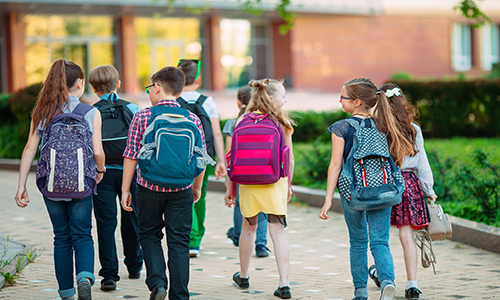
We’ve heard it one too many times: Somehow or another, you are handed your child’s backpack in a hurry and, “What is… what is in here? Bricks?”
Among the pencils boxes, notebooks, folders, and binders, a recent study mentioned in the New York Times found that 6th graders, on average, carry about 18 pounds of stuff to and fro. Jaw-dropping numbers like these devise depressing imagery of a 12-year-old struggling to hoist a sack onto their shoulders several times a day that is a quarter of their weight. Your child has a rapidly growing body, one where the impacts of something like a weighted bag can have drastic influence. Repetitive actions like these can cause a slew of back, neck, and shoulder pain, and can even trigger lousy posture.
Growth spurts are something that adolescents likely experience between the ages of 14 and 18 regardless of their gender, which means the development stages of growth strike just when your child begs for that cool backpack that just so happens to be twice their size. Fear not, for it is not the backpack’s size that matters, but the load that is inside.
The Do’s
- Do consistently monitor backpack weight. The American Chiropractic Association recommends that a backpack weigh no more than 5-10 percent of the child’s weight. For example, if your child is 80 pounds, you should ensure that their bag is no more than 8 pounds.
- Do try to lighten the load. Analyzing what your child brings to school and asking them if they really need it will help them be conscientious about how much they carry. Do they need all those glue sticks and colored pencils today?
- Do educate your child on proper backpack posture. Teach your child early on about how to wear their backpack correctly. According to the National Safety Council, both shoulder straps should always be used to help distribute the weight of the load across the back. Any chest, waist, and compression straps should also be utilized.
- Do consider different backpack styles and fits. A backpack that sits too loosely on your child’s back can be detrimental to their posture. Consider finding a bag that suits your child’s size and can be adjusted to rest close to their body.
- Do encourage conversations about secondary conditions. Children can have secondary conditions (or symptoms) like shoulder, neck, and lower back pain, too, especially if they carry heavy bags every day. When the spine shifts from the extra weight on their back, it can lead to foundational issues that can cause these secondary complaints.
The Don’ts
- Don’t insist on having unnecessary books come home. Instead of planning for those just in case moments when it comes to homework, try encouraging your child to decide what is best to take home. If your child has a locker, desk, or nook at school where they can keep their things, suggest having them visit that spot at the end of each day to drop off any items that will not be needed. Alternatively, it could be a good idea to consider owning a second set of textbooks or school materials to lighten your child’s weight.
- Don’t reinforce an unorganized pack. The empty space a child has in their pack, the more likely it is to plan to fill it. Teaching your child organization methods early on could help them realize the importance of light living.
- Don’t normalize heavy backpack weights. Never think that just because your neighbor’s kids have heavy packs that your child should have one, too.
- Don’t allow yourself to have overbearing bags, either. What’s that phrase? “But you do it. Why can’t I?” If you are encouraging your child to make changes regarding their weighted bags, you might want to do it as well. It isn’t just about being a good example but evaluating your own back, shoulder, and neck health.
- Don’t ignore complaints. Shift happens. Children have spines and can experience Foundational Shifts. If ignored, they can lead to postural abnormalities like scoliosis or Anterior Head Syndrome or develop into chronic headaches or migraines.

Recent Comments